
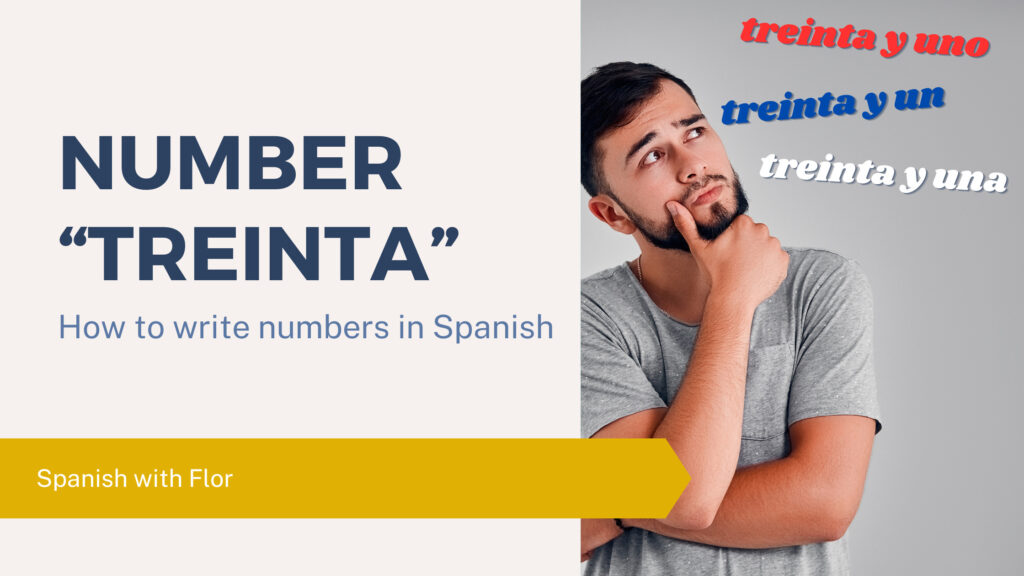
When it comes to Spanish numerical terms, there are a few variations that can cause confusion, especially for non-native speakers. In this article, we will explore the differences between “treinta y uno,” “treinta y un,” and “treintaiún.”
Is “treinta y un” correct in Spanish?
“Treinta y un” is a variation of “treinta y uno” that is used in certain circumstances. Specifically, it is used when the noun being described is masculine. For example, if you were describing “31 days” in Spanish, you would say “treinta y un días” instead of “treinta y uno días.”
Is it correct to say “treintaiuno”?
It is correct to write in one word all cardinal numbers lower than one hundred, such as cuarentaiocho (forty-eight), treintaiuno (thirty-one) or setentaisiete (seventy-seven).
Until the Ortografía de la lengua española, published in December 2010, only numbers lower than thirty, such as dieciséis or veinticuatro, were written in one word, but in this work the Academias de la Lengua consider it admissible, although not the majority in the cultured language, to apply this same rule to other cardinal numbers lower than one hundred.
The words thus formed are written with a Latin i for the letter that corresponds to the conjunction y, such as sesentaiuno, and must be accented according to the general rules, so that the correct words are cincuentaidós, cincuentaitrés and cincuentaiséis, although the numerals two, three and six do not have a tilde when they are written in isolation.
With this same criterion, other compounds of the same type, such as veintitantos (twenty something), veintimuchos, treintaipico (thirtish), cuarentaitantos, in which the numeral is joined to certain indefinites that indicate quantity, are already included in the texts.
Numbers and percentages in Spanish
The word “uno” is replaced by the form “un” when it accompanies a masculine noun, as indicated in the Diccionario panhispánico de Dudas: we do not say, for example, “uno caballo”, but “un caballo“; however, we do say veintiún and cuarenta y un when they are accompanying the locution por ciento, which begins with the preposition por and functions as an adverb.
Therefore, with the expression “por ciento”, one should use uno, not un: “el veintiuno por ciento de los alumnos“, “el treinta y uno por ciento de los residentes“.
Which one is correct: “treinta y uno” or “treinta y una”?
Compound numerals ending in un/una agree with the gender of the noun that follows: treinta y una personas, not treinta y un personas.
According to the Diccionario Panhispánico de Dudas, the numerals uno, una and their compounds agree in gender with the noun they accompany when they immediately precede it: cuarenta y un actores, treinta y una personas, veintiuna mujeres…
