
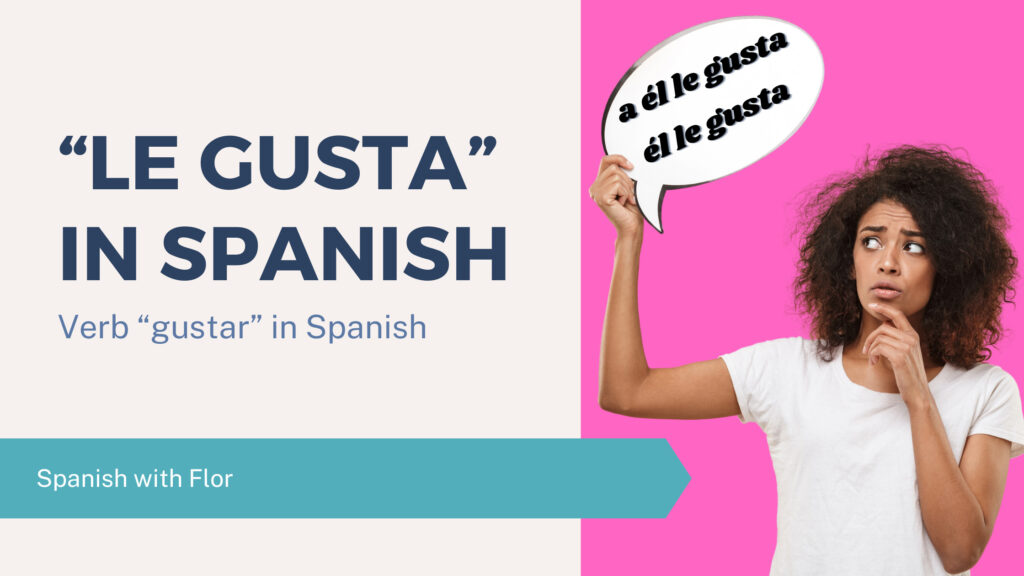
When using the phrase “le gusta” in Spanish, it is important to understand the correct usage of the pronoun. The correct form is “a él le gusta” instead of “él le gusta”. The addition of the preposition “a” clarifies that the pronoun “él” is the indirect object of the sentence.
For example, “A él le gusta el chocolate” means “He likes chocolate”, while “Él le gusta el chocolate” makes no sense. Therefore, it is crucial to use the correct form in order to convey the intended meaning.
Usage of ‘Le Gusta’ in Spanish
The phrase “le gusta” is commonly used in Spanish to express likes and dislikes. In this example it is used in the third person singular form (él / ella / usted), but can also be used with other pronouns. Here are some examples:
- A mí me gusta el café. (I like coffee.)
- A ti te gusta la música. (You like music.)
- A él le gusta leer. (He likes to read.)
- A ella le gusta bailar. (She likes to dance.)
- A nosotros nos gusta el fútbol. (We like soccer.)
- A ellos les gusta viajar. (They like to travel.)
Exploring Variations of ‘Le Gusta’
When it comes to using “le gusta” in Spanish, there are a few variations to consider. In this section, we’ll explore these variations and provide some examples to help you understand how to use them correctly.
“Le / Me / Nos gusta” is commonly used to express likes and dislikes of a singular object or activity. However, it can also be used in the plural form to express likes and dislikes of multiple objects or activities. In this case, “gusta” is replaced with “gustan” to indicate that the subject likes or dislikes more than one thing.
For example:
- A ellos les gustan las montañas. (They like mountains.)
- A ellas les gustan los juegos de mesa. (They like board games.)
- A nosotros nos gustan las películas de terror. (We like horror movies.)
Use with Different Verbs
While “gustar” is the most commonly used verb with “le gusta”, there are other verbs that can be used to express likes and dislikes as well. These verbs include “encantar” (to love), “aburrir” (to bore), and “interesar” (to interest).
For example:
- A ti te encanta el chocolate. (You love chocolate.)
- A ellos les aburren las matemáticas. (They are bored by math.)
- A ella le interesan los libros de historia. (She is interested in history books.)
Learn how to express preferences and much more!

